


Emergency Storm Radios
A radio that keeps working when the mobile network has stopped.
Storm Goretti is a recent example. On 8 and 9 January 2026 Cornwall and the Isles of Scilly had a red wind warning, and gusts the Met Office said could reach 100mph or more. The power failed in places. Where a mobile mast had no backup of its own, the signal failed with it.
Red warning
Isles of Scilly and much of Cornwall, Thursday 8 January, 4pm to 11pm.
100mph or more
Met Office forecast for exposed parts of that red-warning area.
Still down a fortnight later
The Guardian reported some Cornish towns still without broadband on 23 January.
Storm Goretti: the masts went down with the electricity.
Storm Goretti was named by Météo-France. It crossed the south of the UK on 8 and 9 January 2026: violent wind in the far south-west, snow further north, and rain on top. The Met Office put a red warning on the Isles of Scilly and much of Cornwall for the Thursday evening.
Openreach called it the worst impact on their network in Cornwall in recent memory. Much of that network needs mains power. Where Openreach had batteries and generators, many services kept going. Where the power cut outlasted the backup, the service stopped. Openreach also reported nearly 200 poles badly damaged.
The mobile networks had the same weak point. A mobile mast with a flat battery is a mast with no signal, even if the handset in your pocket is fully charged.
“The issue in Storm Goretti, in particular, was that mobile masts did not have any back-up energy generation, so all the masts failed as well.”
Cllr Dwelly told the same discussion about a three-day power cut at his own house. He could not ring the power company from home. He had to go out and look for a signal.
The government is asking households to plan for this.
On 22 October 2026 the Cabinet Office and Security Minister Dan Jarvis published updated advice: take a few small steps now, so a household can cope if everyday services stop for a while. Storms are named in that advice. So are phones and the internet, alongside power and water.
The campaign is called Be Ready. The figure at the centre of it is three days. France, Ireland and the Netherlands use the same stretch of time. The steps they suggest are ordinary:
- Sign up to the Priority Services Register if you need extra support from your gas, electricity or water company.
- Keep a small stock of food that will keep, and some bottled water.
- Write important numbers on paper, including 105 for a power cut. A dead phone cannot show you the number you saved in it.
The advice does not say “buy a two-way radio”. It does say you should not assume the mobile phone will be the thing that still works. A Gould radio is a separate thing: you talk to other radios on our own network. It does not connect to the telephone network.
Dan Jarvis, Security Minister
“Those who can follow this advice should follow this advice. By taking simple steps to be ready for everyday emergencies like severe storms, people can reduce pressure on emergency services.”
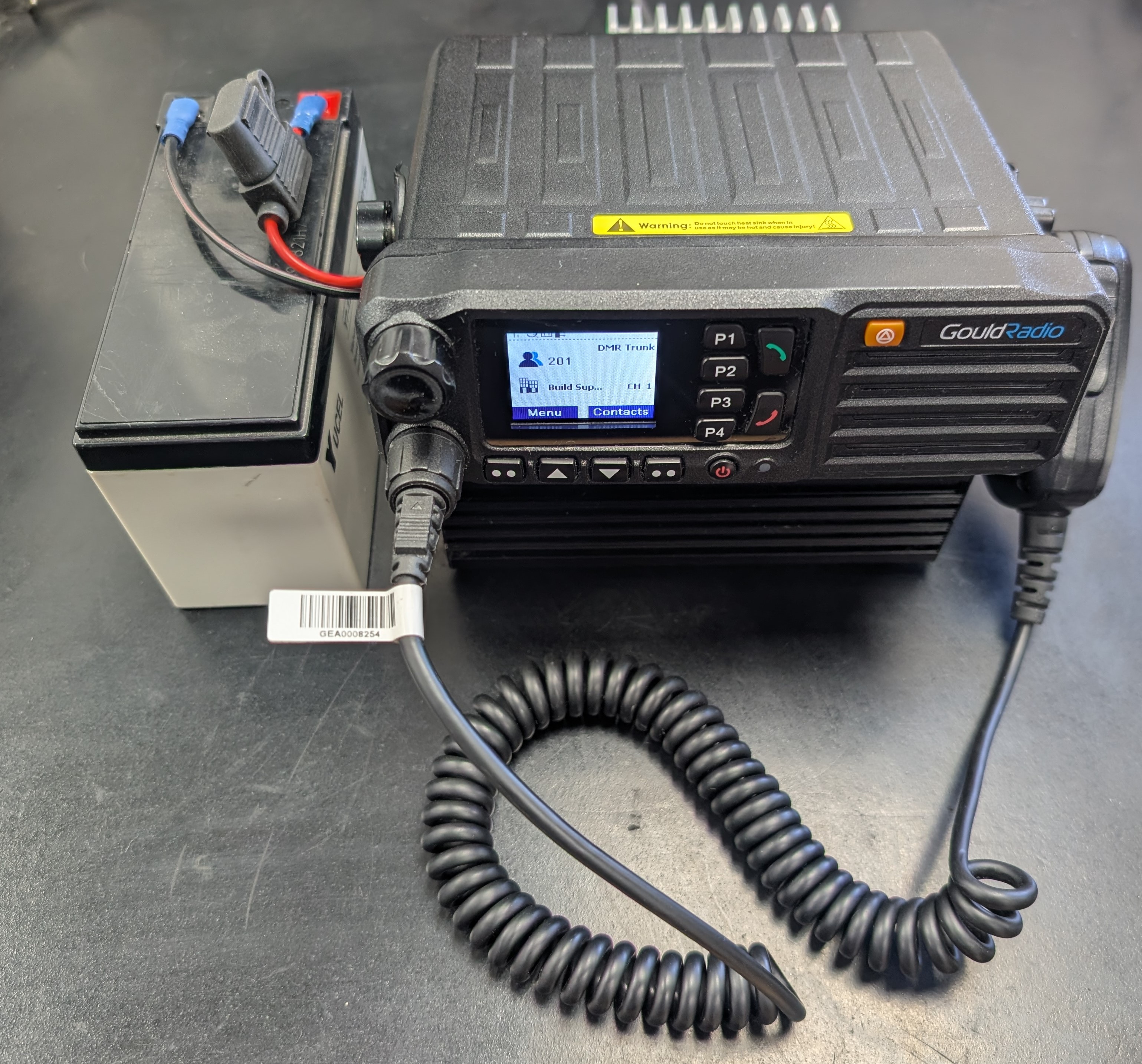
Day to day it runs on the mains. In a power cut the battery takes over.
The set in the photograph is a Gould mobile. In normal use it runs from the mains, and that supply keeps the battery float charged. If the power fails, the battery switches in on its own. Nobody has to move a plug.
It does not use the mobile phone network, and it does not need your broadband. The range comes from our privately owned radio sites.
The same radio will also run straight from a car battery. How long that lasts depends on the size of the battery and how much you transmit. Used the way most people use a radio, listening more than they talk, a car battery can keep it working for days.
Handheld radios
A set that stays with the person. The handhelds we supply, including the Hytera PD705 and the Motorola DP4000e series, are built for rain and a working day. The battery covers a shift. The Hytera handhelds include an emergency button and a lone-worker alarm.
In the vehicle
A mobile such as the Hytera MD785 is made for the desk or the cab. In a vehicle it runs from the 12 volt supply already there, so the driver stays on the radio. The controls are straightforward, and the set is built to live in the vehicle.
These are the same handheld and vehicle radios on our digital radio pages.
Our radio sites can stand on their own.
The range is our infrastructure, not a mobile mast. A Gould radio site normally links back to the rest of that network. If the link fails, or the internet fails, the site can revert to stand-alone. People using that site can still talk to each other on the radio. The storm does not have to take the local radios with it.
The site itself is backed three ways: batteries, solar and a generator. Mains power is useful. It is not the thing the site depends on.
Batteries
The site keeps running after the mains has gone, for as long as the battery bank holds.
Solar
Panels keep charging the batteries through a long daylight outage, without a fuel run.
Generator
If the weather outlasts the batteries and the sun, a generator is the third supply.
Have you thought about how you would talk?
This is a question for a business and for a home. The useful time to answer it is while the lights are on.
At work
If the mobile mast runs flat, can the yard, the office and the person out on the road still hear each other on the radio?
At home
If you cannot leave the house to hunt for a bar of signal, can the people you need still reach you on a radio?
No internet
If the broadband fails, the radios still work through our own sites, including when a site has dropped back to stand-alone.
A standby base, at a lower rate than a normal rental.
We will offer standby emergency bases for businesses and for homes, at a reduced rate against our normal rental fees. The base is there for the week the mobiles and the internet are not. Day to day it sits on the mains, with the battery kept float charged. If the power fails, the battery switches in on its own. It works through our own radio sites, including a site that has dropped back to stand-alone. Handheld and vehicle radios sit on the same system.
There is no telephone interconnect. You talk to the other radios. Ask, and we will quote the standby rate for what you actually need.
Or call +44 (0)1209-821804
Gould Electronics
Highburrow Lane, Wilson Way
Pool, Cornwall TR15 3RT
You do not need a storm for the public networks to stop.
A red warning is the obvious case. Ordinary faults take the mobile networks and the big internet services down as well. These are reported examples, not figures we measured. None of them is “the whole country went dark”. They are large enough to show the point.
| When | What was reported |
|---|---|
| 14 August 2024 | Vodafone confirmed a technical fault that affected some customers. Outage reports of lost mobile internet ran for about three hours, from roughly 12:30 to 4pm. |
| 24–26 July 2025 | Thousands of EE, BT and Vodafone customers reported they could not make or receive voice calls. EE and BT said an overnight fix had calls running as normal by 26 July. For the people affected, that was about two days. |
| 22 January 2026 | Microsoft reported faults with sending and receiving Outlook email, and with Teams, OneDrive and SharePoint. From the company’s own updates that afternoon and night, the incident ran for nearly 11 hours. CNBC also reported a separate Outlook outage the previous July that lasted more than 21 hours. |
A Gould radio does not pass through Vodafone, EE or Microsoft. It uses our own sites. If the site is up, and the set has 12 volts, you can still talk on the radio.
Where these points come from
- Met Office, 8 January 2026: red wind warning for the Isles of Scilly and much of Cornwall, 4pm to 11pm, gusts of 100mph or more. Storm named by Météo-France.
- Openreach, Storm Goretti update: worst impact on their Cornwall network in recent memory; batteries and generators on their side; nearly 200 poles badly damaged.
- Cornwall Live, November 2026: Cllr Loveday Jenkin on mobile masts with no backup generation. Hits Radio Cornwall: Cllr Dwelly on a three-day power cut and no signal at the house.
- The Guardian, 23 January 2026: some Cornish towns still struggling with broadband a fortnight on.
- GOV.UK, 22 October 2026: “Households encouraged to take small, simple steps to stay prepared in an emergency.” Cabinet Office and Dan Jarvis. Three days, in line with France, Ireland and the Netherlands. prepare.campaign.gov.uk
- Vodafone, 14 August 2024, as reported that day: a technical issue, since resolved; outage reports from about 12:30 to 4pm.
- EE and BT statements, 26 July 2025, and reporting of the voice-call fault that began on 24 July across EE, BT and Vodafone.
- Microsoft service updates on 22 January 2026, reported by CNBC: investigating from 2:37pm US Eastern, resolved at 1:29am. CNBC’s note of an Outlook outage of more than 21 hours the previous July.